
The Board recognises the critical importance of ensuring the highest standards of corporate governance.
ROLE OF THE CHAIRplus
The Board currently comprises a Non-executive Chair, three Non-executive Directors and two Executive Directors, who are equally and collectively responsible for the proper stewardship and leadership of the Company. Their biographical details are set out on pages 60 and 61. In accordance with the Code, at least half the Board, excluding the Chair, should be Non-executive Directors, who are determined by the Board to be independent in character and judgement, and free from relationships or circumstances, which may affect, or could appear to affect, this judgement. The Company regards Alison Littley, Iraj Amiri and Angela Rushforth as ‘independent’ Non-executive Directors within the meaning of the Code and, therefore, is considered to be compliant in this area.
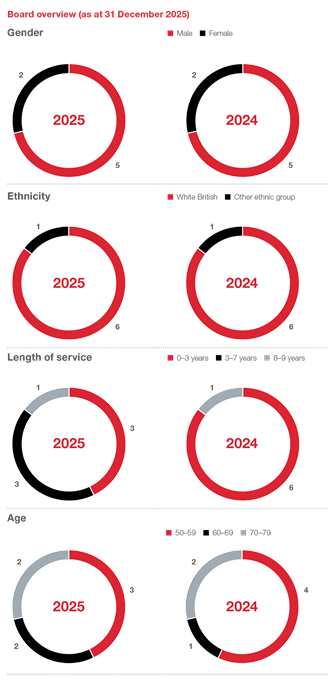
The Board also considers diversity and inclusion throughout the Group and details of the extent to which the Board has met the FCA’s targets, in this regard, are set out on page 76.
The formal schedule of matters reserved for the Board’s consideration includes the following:
- Approval of the Group’s strategy, long-term objectives, annual operating budgets and capital expenditure plans
- Approving transactions of significant value or major strategic importance, including acquisitions
- Approving significant changes to the Group’s capital, corporate or management structure
- Monitoring and assessing the overall effectiveness of the Group’s risk management processes and internal control systems, including those related to health and safety, financial controls and anti-bribery policies and procedures
- Approving the Annual and Half-Year Reports, including Financial Statements
- Approving other corporate communications related to matters decided by the Board
- Board appointments and succession planning and setting Terms of Reference for Board Committees
- Remuneration matters, including the general framework for remuneration and share and incentive schemes.
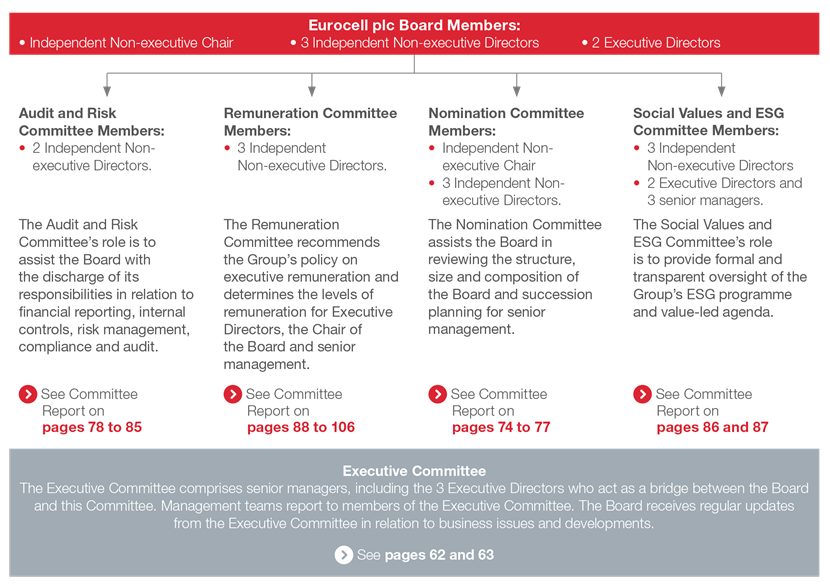
Subject to those matters reserved for its decision, the Board has delegated to its Audit and Risk, Nomination, Remuneration, and Social Values and ESG Committees certain authorities. There are written Terms of Reference for each of these Committees, which are available on the Group’s corporate website at: investors.eurocell.co.uk. Separate reports for each Committee are included in this Annual Report on pages 74 to 106.
Details of how opportunities and risks to the future success of the business have been considered and addressed, can be found in the Strategic Report on pages 52 to 58. Details of the sustainability of our business model can be found in the Strategic Report on pages 20 to 47. Our governance framework underpins the delivery of strategy and can be found on pages 65 and 66. An overview of the Group’s strategy can be found in the Strategic Report on pages 14 to 19.
The Directors are ultimately responsible for preparing the Annual Report and Accounts and the Board confirms it considers them, taken as a whole, to be fair, balanced and understandable, and provides the information necessary for shareholders to assess the Company’s position, performance, business model and strategy.
GOVERNANCE FRAMEWORKplus
The Board meets regularly to discuss key business issues and prescribe actions as appropriate. The Group’s reporting structure below Board level is designed so that all decisions are made by those most qualified to do so in a timely manner. Day-to-day management and the implementation of strategies agreed by the Board are delegated to the Executive Directors. Key to this delegation is the Executive Committee, which meets each month.
This structure enables the Board to make informed decisions on a range of key issues including strategy and risk management.
All the Directors have the right to have their opposition to, or concerns over, the operations of the Board and/or the management of the Company, noted in the minutes. During the year, no such opposition or concerns were noted.
The Chair and the Non-executive Directors met during the year without the Executive Directors present.
ROLE OF THE CHAIRplus
The Board has concluded that the Chair has met the independence criteria of the Code on appointment.
There is a clear division of responsibilities between the Chair and the Chief Executive.
The Chair is responsible for ensuring that the Board functions effectively. He sets the agenda for Board meetings and ensures that adequate time is devoted to discussion of all agenda items, particularly strategic issues, facilitating the effective contribution of all Directors and ensuring that the Board as a whole is involved in the decision-making process.
ROLE OF THE CHIEF EXECUTIVE OFFICERplus
The Chief Executive has principal responsibility for all operational activities and the day-to-day management of the business, in accordance with the strategies and policies approved by the Board. The Chief Executive also has responsibility for communicating to the Group’s employees the expectations of the Board in relation to culture, values and behaviours.
ROLE OF THE SENIOR INDEPENDENT DIRECTORplus
The Senior Independent Director has an important role on the Board, providing a sounding board for the Chair, leading on corporate governance issues and serving as an intermediary for the other Directors. She is available to shareholders if they have concerns, which contact through the normal channels of the Chair, Chief Executive or other Executive Directors has failed to resolve, or for which such contact is not appropriate.
Alison Littley has served as Senior Independent Non-executive Director throughout 2025.
ROLE OF NON-EXECUTIVE DIRECTORSplus
All Non-executive Directors are required to allocate sufficient time to the Company to discharge their responsibilities effectively. The Non-executive Directors act in a way they consider will promote the long-term sustainable success of the Group for the benefit of, and with regard to the interests of, its stakeholders.
BOARD COMPOSITION, COMMITMENT AND ELECTION OF DIRECTORSplus
The Nomination Committee leads the process for Board appointments and makes recommendations to the Board. Prior to appointment, Board members, in particular the Chair and the Non-executive Directors, disclose their other commitments and agree to allocate sufficient time to the Company to discharge their duties effectively and ensure that these other commitments do not affect their contribution.
The Executive Directors may accept an outside appointment provided that such appointment does not, in any way, prejudice their ability to perform their duties as Executive Directors of the Company. Michael Scott and Will Truman’s outside appointments (where applicable) are disclosed on page 60.
The Non-executive Directors’ appointment letters anticipate a minimum time commitment of 20 days per annum, recognising that there is always the possibility of an additional time commitment and ad hoc matters arising from time to time, particularly when the Company is undergoing a period of increased activity. The average time commitment inevitably increases where a Non-executive Director assumes additional responsibilities such as being appointed to a Board Committee.
All new Non-executive Directors undergo an induction programme, and as such, spend considerably more than the minimum commitment during the course of a year. All Non-executive Directors are required to inform the Chair before accepting another position in order to ensure the Director has sufficient time to fulfil their duties. The current Board commitments of all Directors are shown on pages 60 and 61 and their terms of appointment are reported on pages 95 and 96.
The Company’s Articles of Association contain powers of removal, appointment, election and re-election of Directors and provide that all of the Directors must retire and may offer themselves for re-election at each Annual General Meeting (‘AGM’).
At the upcoming AGM, all the current Directors intend to offer themselves for election/re-election, in accordance with the Code.
Following the conclusion of the latest Board evaluation process, the Board considers all the Directors to be effective, committed to their roles and to have sufficient time available to perform their duties.
The Board has a process in place to assess the current and future skills and experience needed by the Non-executive Directors against a matrix of requirements, through which it has determined that the Non-executive Directors are independent and that the Board has appropriate and complementary skills and experience.
BOARD EVALUATION AND EFFECTIVENESSplus
In accordance with the Code, a formal evaluation of the Board’s performance, along with its Committees, Chair and individual Directors was conducted during the year, with the results presented and discussed at the December 2025 Board meeting. This year’s internal evaluation was performed by the Chair. The last external evaluation was led by Haddleton Knight in 2023.
Individual interviews were conducted by the Chair with each Board member and the Group Company Secretary.
Further sessions were held by the Senior Independent Director with each Board member and the Group Company Secretary, to gain feedback for the Chair. All involved fully engaged with the process and provided their qualitative feedback, which supported an open and frank exchange of views.
Progress against the actions arising from the 2024 review was considered and it was noted that:
- Activities to promote greater Board interaction with the wider workforce have been delivered by way of an enhanced schedule of Board listening Groups and increased visibility at operational sites
- Board agendas and standard reporting has developed to be more forward looking
- Externally led training delivered to newer Non-Executive Directors during 2025 was helpful in further improving their knowledge of their duties and responsibilities.
The 2025 evaluation identified several areas of strength and some areas for enhancement and, overall, concluded that:
- The Board continues to operate in an effective and professional manner, with Non-executive Directors continuing to strengthen their knowledge of the business
- Governance processes are transparent and well run, although there is scope to streamline processes to support more agile and responsive decision making
- Risks are openly discussed with deep dive analysis and review of material risks where appropriate
- There remains further scope, and a desire, from the Board to develop further.
In addition, the evaluation highlighted the following actions to strengthen the Board performance:
- Further improvements to be progressed on Board papers and Executive recommendations, to provide greater clarity of message and requirements
- A more detailed process of reporting on and reviewing the product innovation strategy would be beneficial to support dynamic investment decisions
- The Committees operate well, however due to the deterioration in Health & Safety performance during 2025, oversight of this topic will now move to Board level (previously a remit of the Social Values & ESG Committee).
Taking all of this into account, the Board is satisfied that the current composition of the Board, and its Committees, provides an appropriate balance of skills, experience, independence and knowledge to allow the Board and its Committees to discharge their duties and responsibilities effectively and in line with the Code. Due to the changes in Board composition during 2025, it was determined that, in order to better balance Non-executive Director’s time commitments, Angela Rushforth would succeed Alison Littley as Chair of the Remuneration Committee, effective from the 2026 AGM.
CONFLICTS OF INTERESTplus
The duties to avoid potential conflicts and to disclose such situations for authorisation by the Board are the personal responsibility of each Director. All Directors are required to ensure that they keep these duties under review and to inform the Group Company Secretary of any change in their respective positions.
The Company’s conflict of interest procedures are reflected in its Articles of Association (‘Articles’). In line with the Companies Act 2006, the Articles allow the Directors to authorise conflicts and potential conflicts of interest, where appropriate. The decision to authorise a conflict can only be made by non conflicted Directors.
The Board, and its Committees, considers conflicts or potential conflicts at each meeting and, where such instances are identified, takes appropriate action, usually by excluding the conflicted party from any related discussions/decisions.
The Articles require the Company to indemnify its officers, including officers of wholly-owned subsidiaries, against liabilities arising from the conduct of the Group’s business, to the extent permitted by law. The Group carries Directors’ and Officers’ liability insurance.
BOARD MEETINGS AND ATTENDANCEplus
There were six full Board meetings held during 2025, five meetings of the Audit and Risk Committee, three meetings of the Remuneration Committee, two meetings of the Nomination Committee and three meetings of the Social Values and ESG Committee. All of these meetings were held in-person and attendance was as shown in the following table.
FY25 Board and Committee attendance
The table below sets out Board and Committee meeting attendance during the year to 31 December 2025. The number of meetings attended is shown next to the maximum number of meetings that each Director was entitled to attend.
| Number of meetings attended/eligible to attend | Board | Audit and Risk Committee | Remuneration Committee | Nomination Committee | Social Values and ESG Committee |
|---|---|---|---|---|---|
| Derek Mapp | 6/6 | – | – | 2/2 | – |
| Alison Littley | 6/6 | 5/5 | 3/3 | 2/2 | 3/3 |
| Iraj Amiri | 6/6 | 5/5 | 3/3 | 2/2 | 3/3 |
| Angela Rushworth | 5/6 | – | 2/3 | 1/2 | 2/3 |
| Will Truman | 6/6 | 5/5 | 3/3 | 2/2 | 3/3 |
| Darren Waters | 6/6 | – | – | – | 3/3 |
| Michael Scott | 6/6 | – | – | – | 3/3 |
All Board members, including the Chair of the Board, the Chief Executive, and the Chief Financial Officer, are invited to all Committee meetings regardless of whether they are members of the Committee. However, they are never involved in discussions or decisions pertaining to their own compensation or appointment or replacement. In addition, the Audit and Risk Committee also meets with the external auditors without any Executive Directors being present.
The Group Company Secretary is also Secretary to the Audit and Risk, Remuneration, Nomination, and Social Values and ESG Committees, and attends all meetings for this purpose.
In order to provide Directors enough time to evaluate their papers beforehand, Board packs are issued the week before each meeting. Even if a Director is unable to attend a Board meeting for any reason, they are nevertheless informed beforehand, given access to pertinent documents, and their opinions are shared with the other Directors.
GROUP COMPANY SECRETARYplus
The Group Company Secretary’s services and advice are available to all Directors. In addition to advising the Board on all governance-related issues through the Chair, the Group Company Secretary has responsibility for making sure that all Board processes are followed.
The Board receives updates from the Group Company Secretary on new laws, corporate governance and regulatory matters, and the responsibilities and duties of the Directors. Among the matters reserved to the Board is the appointment and removal of the Group Company Secretary.
Vicky Williams has served as Group Company Secretary throughout 2025.
Directors may, at the Company’s expense, seek independent expert assistance as needed. Board Committees confirm annually that they have access to sufficient resources to carry out their responsibilities, including the ability to hire outside consultants as they see fit.
BOARD INDUCTION, DEVELOPMENT AND SUPPORTplus
Following appointment, a new Director undergoes an induction programme, which includes a teach-in from members of the Executive Committee on important business topics, such as the background to our markets and industry, the Company’s strategy, commercial approach, manufacturing and logistics operations, administrative functions and culture.
Summary of induction programme:
| Understand the business |
|
| Meet our colleagues |
|
Individual development and training needs are identified through the Board evaluation process and through individual reviews between the Directors and the Chair.
RISK MANAGEMENT AND INTERNAL CONTROLplus
The Board recognises that it is responsible for determining the nature and extent of the risks it is prepared to face in order to accomplish its strategic goals and for the oversight of the Group’s internal control systems.
The effectiveness of the Group’s internal control and risk management systems has been reviewed and assessed by the Board through the consideration of reports received from both management, and KPMG as part of our internal audit programme. This includes an assessment of the financial, operational, and compliance controls for the time period covered by this Annual Report, as well as an evaluation of current and emergent risks.
The Strategic Report comments in detail (pages 02 to 63) on the nature of the principal risks and uncertainties facing the Group; in particular those that would threaten our business model, future performance, solvency or liquidity and the measures in place to mitigate them.
In conducting its review, the Board has included a robust assessment of these and other emerging risks and the effectiveness of mitigating controls.
The Audit and Risk Committee Report on pages 82 to 87 describes the internal control system and how it is managed and monitored.
The Board confirms that no significant failings or weaknesses were identified in relation to the review. The Board also recognises that these systems can only offer a reasonable level of assurance against material misstatement or loss and that they are designed to manage rather than eliminate the risk of failing to meet business objectives.
STAKEHOLDER ENGAGEMENTplus
As required by s172 of the Companies Act 2006, the Directors of the Company must act in the way they consider, in good faith, would most likely promote the success of the Company for the benefit of its shareholders. In so doing, the Directors must have regard (among other matters) to:
- The likely consequences of any decision in the long term
- The interests of the Company’s employees
- The need to foster the Company’s business relationships with suppliers, customers and others
- The impact of the Company’s operations on the community and the environment
- The desirability of the Company maintaining a reputation for high standards of business conduct
- The need to act fairly as between members of the Company.
To better comprehend the effects of its decisions and operations, as well as the interests and viewpoints of our major stakeholders, the Board takes into account information from all areas of the business. This covers topics including key risks, legal and regulatory compliance, plus evaluations of strategy, financial performance, and operational performance. The Board and its Committees receive this information through reports that are circulated before each meeting and, where necessary, in person presentations.
As a result of these activities, the Board has gained a thorough understanding of the interests and viewpoints of all key stakeholders, as well as other relevant factors, which helps the Directors comply with the requirements of section 172 of the Companies Act of 2006.
The table overleaf sets out the Board’s approach to stakeholder engagement in the context of some of the most important decisions made during 2025. The Board will sometimes engage directly with certain stakeholders on certain issues, but the size and distribution of our stakeholders and of the Eurocell Group dictate that stakeholder engagement often takes place at an operational level. To give greater understanding to this, we have provided clear cross-referencing to where more detailed information can be found in this Annual Report.
The disclosures on the Company’s substantial shareholders, restrictions on voting rights and powers to amend the Articles of Association are included within the Director’s report on page 107.
| Why they matter |
Customers - The Board recognises that establishing strong and lasting relationships with our customers is essential to our growth ambitions. To become the supplier of choice, we must, among other things, continually improve our product offerings, quality, availability, and service. Shareholders - The Board recognises the importance of engaging with all shareholders and places a high priority on having productive conversations to gather feedback, and act on areas of interest and concern, as well as ensure that our regulatory obligations are met. Colleagues - The Board recognises that our colleagues are the major drivers of the Company’s performance and success and, therefore, the importance of providing a safe workplace that values diversity and inclusion, and provides employees with the opportunities to advance in their careers and reach their full potential. Suppliers - The Board appreciates that, to operate effectively, we must ensure secure supplies of good quality sustainable materials at a fair price from suppliers with high ethical standards, and monitor supplier performance against appropriate metrics. Communities and environment - Environmental, Social and Governance (‘ESG’) considerations have been a key part of the Board’s agenda again in 2025, as we further developed our plans in this very important area. The Board understands the role all organisations have to play in protecting the environment and in mitigating the impact of climate change. The Board also recognises the need to support the local communities in which our larger facilities are located. Government and regulatory/ industry bodies - The Board recognises the critical importance of ensuring the highest standards of corporate governance, including compliance with the rules for listed companies and other relevant regulations (e.g. health and safety, and taxation), which together give us our licence to operate. |
| How we engage |
Customers - Regular contact between senior management and key customers Review of insight surveys including Net Promoter Scores and Trustpilot ratings Periodic forums with customer groups to discuss product design and innovation Ongoing monitoring of social media platforms for relevant comments/issues. Shareholders - Comprehensive investor relations programme and regular dialogue with the investment community Formal analyst presentations and investor meetings following the announcement of the Group’s half-year and full-year results Investor meetings following trading updates and otherwise ad-hoc meetings throughout the year Annual General Meetings. Colleagues - Regular senior management team briefings on progress with the strategy, operational and financial performance, with a summary cascaded through the organisation Monthly Company magazine, focusing on information-sharing and colleague engagement Periodic staff surveys, with results used to drive change and improvement Regular attendance by Executive Committee members on safety walks and at safety stand-downs Board-level sponsorship for review of whistleblowing reports and subsequent lessons learned. Suppliers - Regular review meetings between senior management and key suppliers, covering topics such as pricing, supply continuity and service levels Formal tender processes conducted for large/high-value suppliers Engagement with suppliers on how we can support each other on environmental matters Clear communication of our expectations for suppliers in terms of conduct and ethics. Communities and environment - Leading UK-based recycler of PVC windows Ongoing review of our environmental impact and action plans to reduce this Consultation with our suppliers to achieve reductions in carbon emissions across our value chain Major operational sites engage with, and support, local communities. Government and regulatory/ industry bodies - Adherence to the UK Corporate Governance Code principles and provisions Clear policies to help prevent wrongdoing, including whistleblowing, bribery and corruption, fraud, financial crime and modern slavery, with training provided where appropriate Regular meetings with tax advisers to review tax compliance and HMRC correspondence Members of the Windows and Recycling groups of the British Plastics Federation and the British Fenestration Rating Council, which provide a forum to understand changes in relevant legislation and building standards. |
| How the board complements engagement efforts |
Customers - Throughout 2025, the Board received regular updates on our performance against customer and service-related KPIs, compared to historical and industry/sector benchmarks, and offered their input and sector advice on new initiatives. Shareholders - The Board is committed to delivering sustainable value for our shareholders and engaged with investors during the year as follows:
Colleagues - Non-executive Director listening groups to gather colleagues’ views on important topics Suppliers - During 2025, cost inflation continued to be discussed at all Board meetings and updates. Board members shared their ideas and experiences on supplier relationships and engagement, in the light of current risks and challenges. Communities and environment - The Board provides oversight on these matters through the Social Values and ESG Committee and maintains an open dialogue with our advisers, CEN Group, who regularly attend Committee meetings to engage on ESG topics. Government and regulatory/ industry bodies - The Audit and Risk Committee receives regular reports on governance, regulatory and compliance matters from management and from external and internal auditors. The internal audit programme is designed to provide assurance in this area. In addition, the Board receives updates on matters such as developments in building regulations and our associated new product development initiatives. |
| How their interests were considered during 2025 and key decisions arising |
Customers - Our Customer Growth and Business Effectiveness strategic pillars include continued progression of initiatives to enhance our customers’ experience and deliver our ambition to be the trade customer’s preferred choice. During the year, the Board:
Shareholders - Investor relations is covered at all Board meetings and updates Investor feedback is considered when reviewing our capital allocation policy decisions, which are designed to drive shareholder returns through a combination of ordinary dividends and share buybacks. Colleagues - During 2025, management’s proposals and activities relating to our People First strategic pillar were considered by the Board with the following actions arising:
Suppliers - The Board continued to work with, and advise, management on their approach, including:
Communities and environment - Approval of the project to install solar panels at our head office and distribution centre during 2025 Monitoring of external ESG rating’s agency assessments of the Company’s disclosures Review of the ESG ambitions and plans for the next two-year period, confirming our ongoing commitment to delivering our stated targets and ambitions. Government and regulatory/ industry bodies - Review of the 2024 revisions to the UK Corporate Governance Code to support compliance from the effective date of f inancial years beginning on or after 1 January 2025 (1 January 2026 for the effectiveness of the Company’s material controls) guided by the Audit Committee Review of the Company’s arrangements to prevent wrongdoing, including whistleblowing, bribery, corruption, fraud, financial crime, and modern slavery Approval of the Company’s tax policy Review of the requirements of the Economic Crime and Corporate Transparency Act 2023. |
ENGAGEMENT WITH THE WORKFORCEplus
As described in Stakeholder engagement on pages 70 to 73, we acknowledge that our colleagues provide the foundation for our Company’s performance and success, and that in the present social, political, and economic climate, active engagement is more important than ever.
To supplement the team briefings, continuous improvement workshops, and health and safety forums already in place, the Group hosts a variety of colleague engagement initiatives. These include:
- A digital Company magazine, ‘Eurocell & You’, which updates on performance and other important activities around the Group, with a focus on information sharing and colleague engagement
- Frequent colleague focus groups with the designated Non-executive Director, Alison Littley, to ensure that the Board hears the opinions of the workforce
- Departmental listening groups to allow colleagues to provide direct feedback from which appropriate action plans can be formulated
- Group-wide staff surveys, to provide invaluable insight into how our colleagues feel
- Review of retention and recruitment challenges, to identify areas for improvement and ensure we remain competitive in the labour market
- Improvements to the induction process for new colleagues
- More flexible working arrangements, including hybrid working when appropriate
- Improvements in colleague facilities and restrooms as part of an overall staff welfare improvement programme
- Ongoing opportunities for all colleagues to become shareholders through the Save As You Earn scheme.
The Board evaluates and tracks culture through:
- Examining staff survey results and response rates
- Reviewing staff turnover rates
- Scrutinising health and safety data including near-misses
- Reviewing colleague whistleblowing cases
- Engaging with senior management and colleagues
- Observing attitudes towards internal and external auditors and regulators like HMRC and HSE.
Through the implementation of consistent annual salary evaluations, annual bonus target-setting, and benefit entitlement, executive compensation has been, and remains, in line with the Company’s overall pay policy. As a result, it has not been considered necessary to engage with colleagues on this matter.
Overall, the Board recognises that culture, including values and behaviours, is evolving across the Group.
STATEMENT OF COMPLIANCE WITH THE CODEplus
This Corporate Governance Statement, together with the Nomination Committee Report, the Audit and Risk Committee Report, Social Values and ESG Report and the Remuneration Committee Report, provide a description of how the principles and provisions of the Code have been applied during the year.
It is the Board’s view that, during 2025, Eurocell plc was in compliance with the relevant provisions set out in the Code in all material respects.
This statement complies with sub-sections 2.1, 2.2(1), 2.3(1), 2.5, 2.7, 2.8(a) and 2.10 of Rule 7 of the Disclosure Rules and Transparency Rules of the Financial Conduct Authority. The information required to be disclosed by sub-section 2.6 of Rule 7 is shown on pages 112 to 115.
ANNUAL GENERAL MEETINGplus
Our AGM will be held at our Head Office (see Company Information on page 173 for details) on 14 May 2026.
The notice of our AGM, together with the Directors’ voting recommendations on the resolutions to be proposed, is included on a separate circular to shareholders and will be dispatched at least 21 clear days before the meeting. The notice will be available to view at investors.eurocell.co.uk.
All Directors intend to attend the AGM, including the Chairs of the Audit and Risk, Remuneration, Nomination and Social Values and ESG Committees, who are available to answer questions.
The Board welcomes questions from shareholders who have an opportunity to raise issues informally or formally before or during the meeting.
For each proposed resolution, the proxy appointment forms provide shareholders with the option to direct their proxy vote either for, or against, the resolution or to withhold their vote. The proxy form and any announcement of the results of a vote make it clear that a ‘vote withheld’ is not a vote in law and will not be counted in the calculation of the proportion of the votes for and against the resolution.
All valid proxy appointments are properly recorded and counted by Equiniti, the Company Registrars. Information on the number of shares represented by proxy, the proxy votes for and against each resolution, and the number of shares in respect of which the vote was withheld for each resolution, together with the proxy voting result, are given at the AGM. The total votes cast, including those at the AGM, are published on our website (investors.eurocell.co.uk) immediately after the meeting.
- Next Committees